


Real estate investment
How to calculate the return on a real estate investment

Summary: the real return on a real estate investment is not the sale price minus the purchase price. You need to subtract purchase taxes, refurbishment, holding costs, sale taxes and commissions from the gross profit, and then divide the net profit by the total capital invested. With representative figures, a buy-renovate-sell operation with a healthy margin usually targets around 15-20% net profit.
Buying cheap and selling higher is not the metric that matters. What matters is what remains after taxes, refurbishment and management costs have been paid, and that figure almost never matches the first calculation made by eye.
Gross return vs. net return
The gross return is the easiest to calculate and the easiest to misread:
Gross return = (Sale price - Purchase price) / Purchase price x 100It does not include taxes, refurbishment costs or transaction costs. It is useful as a quick first filter, but not as the basis for deciding whether a deal is worth pursuing.
The net return subtracts the real costs:
Net return = Net profit / Total investment x 100Net profit is the sale price minus every cost linked to the operation. Total investment includes the purchase price plus everything required to reach the sale.
Which costs should be included?

At purchase
- ITP on second-hand housing, or VAT + AJD on new-build property. The exact rate depends on the autonomous community.
- Notary and Land Registry fees.
- Administrative management fees, if you use a gestor to process the purchase.
During ownership
- IBI property tax, either for the full year or proportionally for the period you hold the asset.
- Owners’ community fees.
- Property insurance.
- Utilities, if they remain active during the refurbishment.
During refurbishment
- Materials and labour, with a fixed budget whenever possible.
- A contingency margin: for older apartments, an additional 10-15% over the works budget is a reasonable starting point.
- Technical fees if a project, licence or site management is required.
At sale
- Municipal capital gains tax (plusvalia municipal / IIVTNU), which depends on the local authority.
- Capital gains tax in personal income tax if you buy as an individual, or corporate tax if the purchase is made through a company.
- Real estate agency commission, if the sale is handled through an agency.
These percentages depend on the region, the municipality and the moment of the transaction. They are not fixed figures. The important point is not to leave any of these items out of the calculation.
Complete numerical example
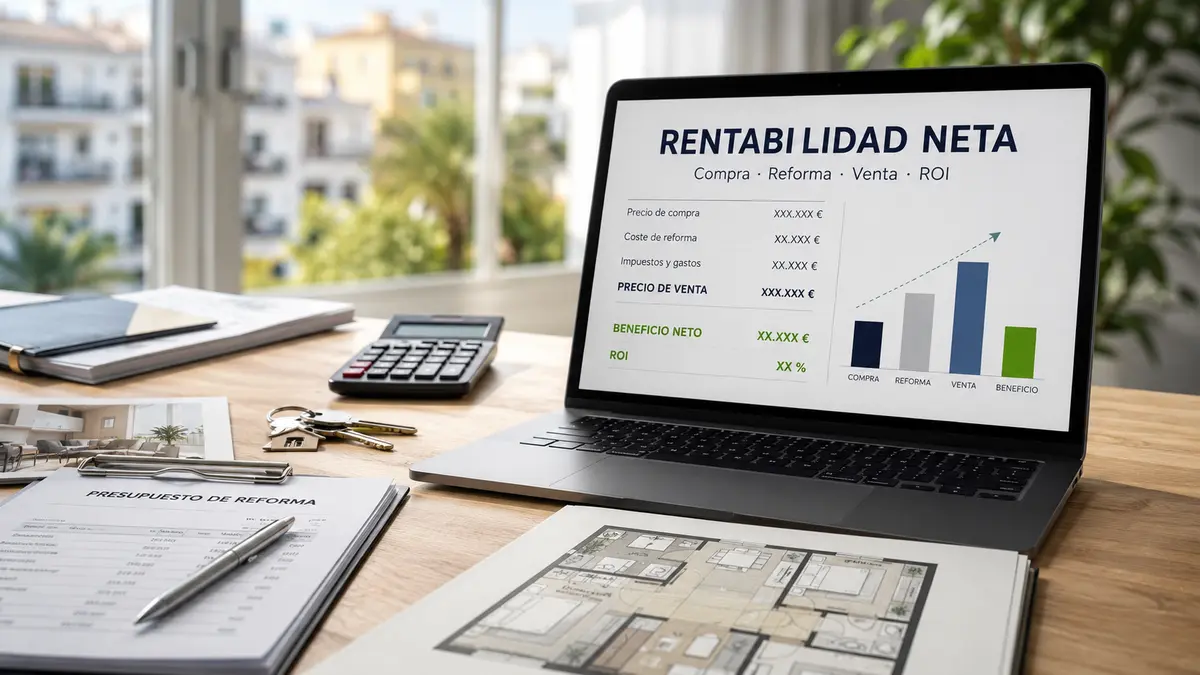
Representative figures, not a real operation. The purpose is to show the method, not to provide a tax rate for a specific case.
Purchase: apartment for 120,000 EUR
- ITP (8%): 9,600 EUR
- Notary + Land Registry + gestor: 1,800 EUR
- Purchase subtotal: 131,400 EUR
Refurbishment: 25,000 EUR budget + 3,000 EUR contingency = 28,000 EUR
Holding costs for 6 months: IBI + community fees + insurance = approximately 900 EUR
Total investment: 131,400 EUR + 28,000 EUR + 900 EUR = 160,300 EUR
Sale: 195,000 EUR
- Municipal capital gains tax: 1,200 EUR
- Estimated personal capital gains tax on the profit: 6,500 EUR
- Agency commission (3%): 5,850 EUR
- Sale cost subtotal: 13,550 EUR
Net profit: 195,000 EUR – 160,300 EUR – 13,550 EUR = 21,150 EUR
Net return: 21,150 EUR / 160,300 EUR x 100 = approximately 13.2% in 6 months
Compared with the simple gross return ((195,000 – 120,000) / 120,000 = 62.5%), the difference is significant. That 62.5% figure is not useful unless all real costs are deducted.
Flipping vs. rental: they are not calculated the same way

In house flipping, the return is linked to a closed operation: it is calculated once the asset is sold.
In rental investment, the calculation is annual, because income is recurring:
Annual net rental yield = (Annual rental income - Annual expenses) / Total investment x 100Comparing a 13% return in 6 months from flipping with a 5% annual rental yield makes little sense unless the timing is considered. But it is also not as simple as multiplying by two: flipping is not automatically repeatable every semester, because each new deal depends on finding another property with the right conditions.
Common mistakes when calculating return
- Forgetting ITP or VAT + AJD in the initial calculation.
- Not budgeting for refurbishment contingencies, which are common in older properties.
- Ignoring municipal capital gains tax or the taxation of the sale profit.
- Calculating on the purchase price instead of the total investment: purchase, refurbishment and holding costs.
- Assuming an optimistic sale price without comparing it with similar completed transactions in the area.
At NEXEVO we review these numbers before buying, not afterwards: documentation, refurbishment viability and a realistic estimate of costs and taxes, so the return calculated at the beginning is closer to the result obtained at the end.
If you want to see this calculation applied to a buy-renovate-sell operation in Valencia, Alicante or Castellon, read our full guide: Real estate investment in the Valencian Community: how house flipping works.
If you want to manage capital in a real estate investment project from start to finish, see Property investment in Spain.
Frequently asked questions
Gross return is the profit divided by the investment, without deducting taxes or transaction costs. Net return deducts the real costs of the operation: purchase, refurbishment, holding costs and sale costs.
Keep reading

Your Ibiza Property Has No Final de Obra: What to Do Next
No final de obra or cédula de habitabilidad on your Ibiza property? Here's what it blocks, why it happens, and how to fix it. Talk to…

Real estate investment in the Valencian Community: how house flipping works
Investing in house flipping in the Valencian Community: sourcing, auctions, refurbishment and sale with NEXEVO. Target profit of 15-20%.

Stalled construction: what to check before investing more money
What to review when construction stops: the building’s condition, project documents and remaining budget, so you can compare your options before investing more.