


Paperwork and permits
Your Ibiza Property Has No Final de Obra: What to Do Next

If a survey, a notary or a utility company has just told you your Ibiza property has no final de obra (completion certificate), you are not looking at a lost cause. You are looking at a paperwork gap that is common on the island — and one that has a clear, if sometimes slow, path to fixing.
This happens more often in Ibiza and Mallorca than on the Spanish mainland. Older builds, self-managed extensions, and properties that changed hands informally over the years often reached the market without ever closing the technical file. The building itself may be perfectly sound. What’s missing is the paper trail proving it.
What «final de obra» actually is
The certificado final de obra is a technical document signed by the project’s architect and technical architect (arquitecto and arquitecto técnico), stating that construction was completed as approved and complies with the regulations in force. It’s not a formality — it’s the evidence a public authority needs before recognising the building as finished.
In the Balearic Islands, this certificate feeds into the cédula de habitabilidad, issued by the relevant Consell Insular under Balearic housing law. The cédula — not the final de obra certificate itself — is the document you’ll actually be asked for at each practical step: connecting utilities, formalising a sale, or renewing a rental contract. Without a valid one, on paper the property isn’t confirmed fit for residential use, whatever its real condition.
This is worth stating plainly, because the mainland works differently: in the Comunitat Valenciana, the equivalent chain runs through a licencia de primera ocupación issued by the town hall rather than a Balearic-style cédula. If you’re comparing a property in Ibiza with one near Valencia, don’t assume the same document or the same authority applies.
What you can’t do without it
- Contract utilities at a residential rate. Suppliers are legally required to ask for the cédula before connecting water and electricity as a home rather than a construction site.
- Sell with full legal certainty. A notary can still authorise a sale, but a buyer’s lawyer — or their mortgage lender — will usually flag the missing cédula and either push for a price reduction or walk away.
- Get a mortgage on the property. Lenders routinely require it as part of the file.
- Rent it out formally, particularly for tourist use, where licensing depends on the property already being legally habitable.
Why this happens so often on the island
Three patterns come up repeatedly in Ibiza and Mallorca: a rural or older property that was extended without closing the paperwork at the time; a cédula that simply expired (it’s valid for 10 years in the Balearics and needs renewing, not just checking); and a change of ownership where nobody chased the missing document because the building was, in practice, already being used as a home.
None of these mean the property has a structural problem. They mean the administrative file was never finished, or was finished once and allowed to lapse.
Your three realistic paths forward
1. Regularise as-built. If the construction matches, or can be brought to match, current planning rules, a technical survey can support a late final de obra certificate and the cédula application that follows. This is the most common outcome.
2. Partial legalisation. If part of the build exceeds what the original licence allowed, some jurisdictions accept a declaration covering the legal portion while the excess is addressed separately. Whether this applies depends entirely on the specific plot and municipality.
3. Renewal only. If the property once had a valid cédula that has simply expired, this is usually the fastest route — a technical re-inspection rather than a full regularisation file.
Which path applies depends on the property’s planning history, not on how the paperwork looks today. This is exactly why a site visit and a documentary review come before any recommendation, not after.
What NEXEVO checks before recommending a path
We don’t propose a fix before we’ve looked at the actual file: the nota simple from the Land Registry, the original building licence if one exists, and the planning status of the plot with the relevant town hall or Consell Insular. That sequence tells us which of the three paths is realistic — and roughly what it will cost and how long it will take.
Costs and timelines vary enormously by municipality and by how far the property is from a straightforward regularisation, so any figure discussed is a preliminary estimate subject to documentary, technical, economic and legal review — never a fixed quote given before that review.
Frequently Asked Questions
Legally, sometimes — but most buyers’ lawyers and mortgage lenders will require it or demand a price adjustment that reflects the risk they’re taking on.
Talk to us before you commit to a fix
NEXEVO reviews the property’s documentary and planning status before recommending regularisation, partial legalisation or renewal — the same due-diligence approach we apply to every project we take on in the Comunitat Valenciana, Ibiza and Mallorca.
Keep reading
Real estate investment in the Valencian Community: how house flipping works
Investing in house flipping in the Valencian Community: sourcing, auctions, refurbishment and sale with NEXEVO. Target profit of 15-20%.
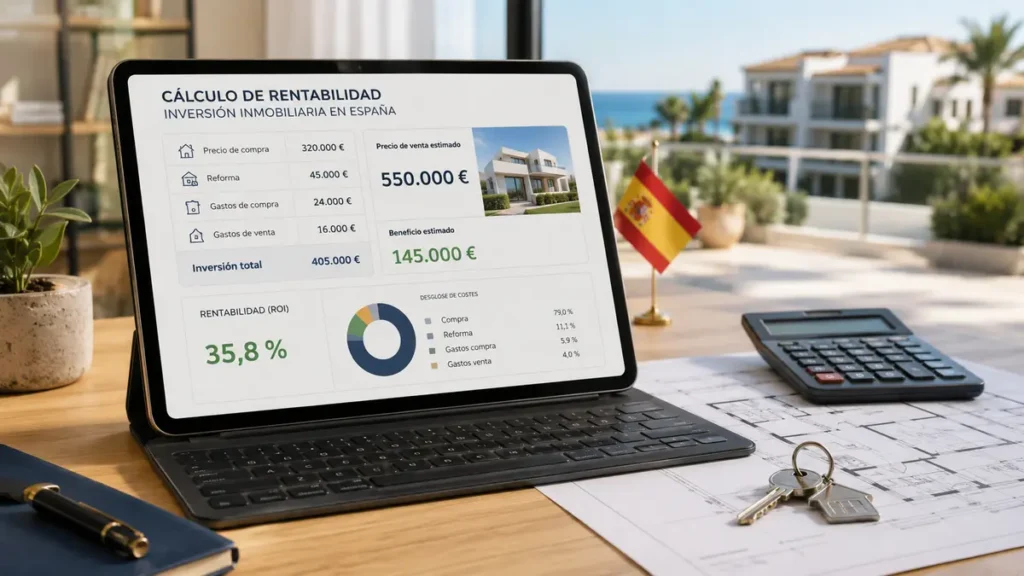
How to calculate the return on a real estate investment
Gross and net real estate investment return formula, which costs to include and a complete numerical example step by step.
Stalled construction: what to check before investing more money
What to review when construction stops: the building’s condition, project documents and remaining budget, so you can compare your options before investing more.