

Paperwork and permits
Buying property for tourist use in the Valencia Region: legal viability and technical alternatives in 2026
As of August 2026, obtaining a tourist licence in the Valencia Region depends on the urban planning compatibility of the specific municipality and on each town hall’s own restrictions. Local moratoriums, independent-access requirements and floor-level rules mean approval is no longer automatic for a property intended for Airbnb.
Put plainly: the classic sequence — buy first, renovate next, ask about the licence last — has been reversed. Regulatory verification now comes before the deposit.
A technical and documentary viability study is essential before you buy or renovate. At NEXEVO we work precisely in that earlier stage, while decisions can still be made without capital committed. (Preliminary estimate, subject to documentary, technical, financial and legal review.)
The shift in the holiday rental market
Why «buy, renovate, list on Airbnb» no longer works automatically
For years the operation ran in three steps and the licence was taken for granted. Today it runs the other way round: authorisation depends on whether the municipal plan admits tourist use on that specific plot — and the answer can be no, even if the property is in perfect condition and the street is full of holiday lets already operating.
The risk isn’t theoretical. It’s a property bought and renovated that cannot be entered in the tourism register.
Town halls set the decisive filter
Regional law sets the framework, but the decisive filter is municipal. Every town hall in the Valencia Region defines its own urban planning compatibility, and some — Valencia city among them — maintain suspensions or moratoriums blocking new licences in certain zones.
Two identical properties in different municipalities, or even in different neighbourhoods of the same city, can get opposite answers.
What to check before buying or renovating

Urban planning compatibility and the municipal report
This is the first document to request, not the last. The urban planning compatibility report states whether tourist use is admitted at that location. Without it, any yield projection is a hypothesis.
Technical requirements: floor level, access, habitability
Three conditions that rule out operations regularly:
- Floor level. Many municipal rules restrict tourist use to ground or first floors, or require that no residential dwellings sit below the unit.
- Independent access. Some town halls require direct street entry, without crossing the building’s communal areas.
- Occupancy licence (licencia de primera o segunda ocupación). This certifies habitability. Without it there is no activity registration and no utility contracts.
Documentary status
Cadastral reference, nota simple (Land Registry extract) and the validity of any existing licences. The nota simple reveals charges, debts and — the point most often missed — homeowners’ association statutes that expressly prohibit holiday letting.
Categories of tourist accommodation: the legal differences
- Tourist dwelling (VUT). Residential home let in full to tourists for short stays (the Airbnb model). Highly exposed to local ordinances and moratoriums.
- Tourist apartment. Property designed for tourist activity, with required fittings and shared services run by a management company. Tertiary or compatible residential use.
- Tourist apartment block. An entire building under a single operating entity. Enables larger-scale projects.
- Hostal. Hotel establishment of a lower category, with greater technical flexibility. Environmental licence plus strict fire, evacuation and accessibility rules.
- Pensión. Basic lodging for short stays. Lower minimum-surface requirements, but still needs tertiary lodging use.
- Small / boutique hotel. Full-service accommodation on a reduced scale. Regional hotel regulations, architect-certified plans, environmental licence.
- Regulated accommodation with environmental licence. Tertiary recreational or hotel-use establishment. Usually falls outside the moratoriums that hit residential tourist dwellings.
That last category explains why many investors are redirecting their operations: the moratorium that blocks a residential holiday flat does not always reach a regulated establishment.
The real risks of buying blind
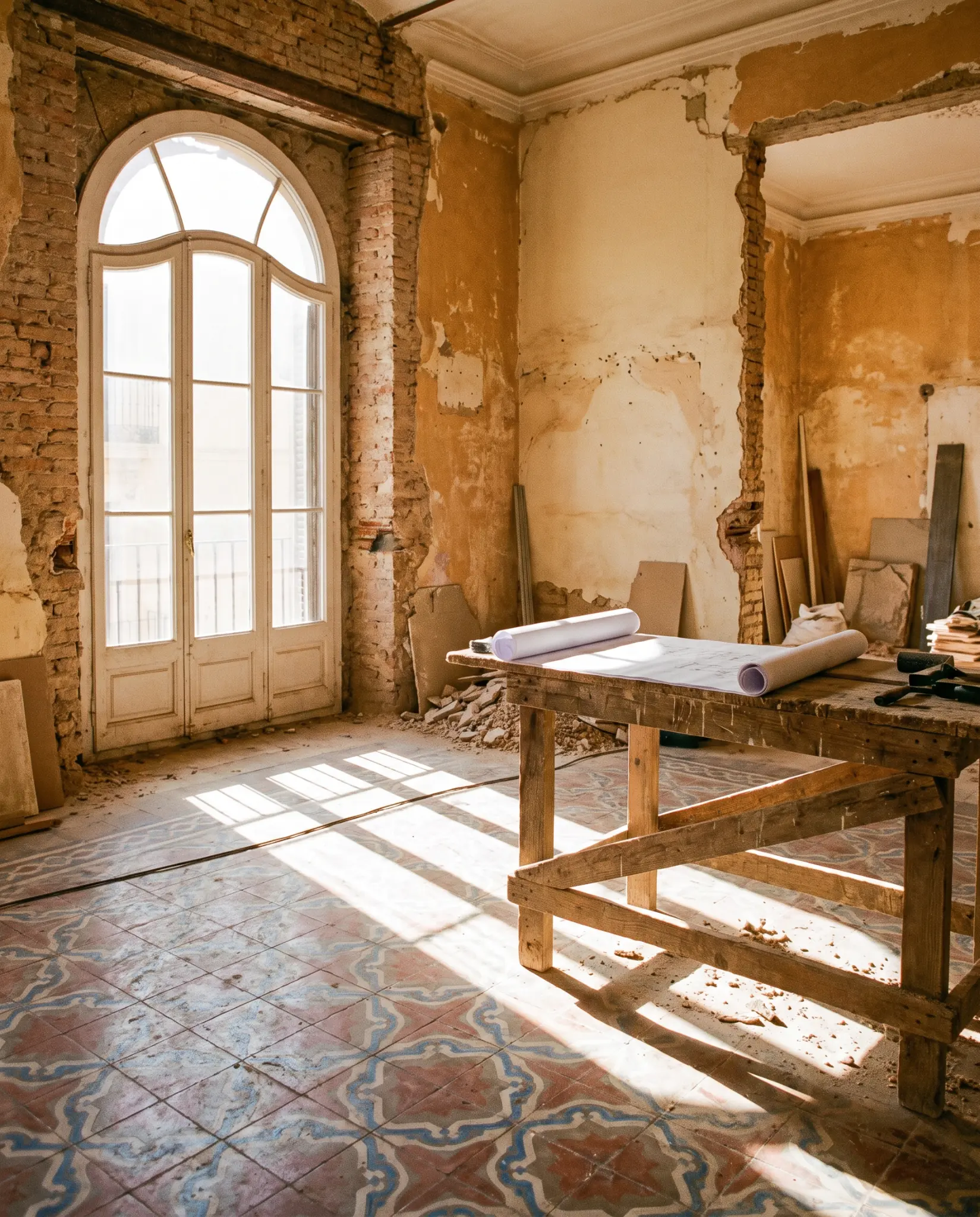
- Capital lost on unusable renovation. An adaptation refurbishment typically runs between €250/m² and €1,200/m² depending on complexity. That spend is unrecoverable if the property never reaches the register. (Preliminary estimate, subject to documentary, technical, financial and legal review.)
- Cease-and-desist orders and sealing. Operating without valid authorisation can trigger penalty proceedings from the town hall or the Generalitat Valenciana, with fines and forced closure.
- Capital trapped in a restricted zone. Buying on the assumption that short-stay demand will carry the investment, then discovering a moratorium that bars new licences.
- Non-refundable deposits. Signing an arras contract without a get-out clause conditional on a favourable urban planning report turns a municipal «no» into a direct loss.
Alternatives when the VUT route is closed
A blocked Airbnb model doesn’t close the operation. It opens others:
- Buying a whole building. Easier to meet access, structural and safety requirements for a hostal, pensión or small regulated hotel. Buying the building guarantees no licence whatsoever: the project remains subject to municipal planning.
- Change of use from commercial premises to dwelling. If the asset is a shop unit, assess conversion to residential or mid-term seasonal letting.
- Residential repositioning. Long-term rental, co-living, or traditional buy-renovate-sell.
Frequently asked questions
No. A whole building makes it easier to meet the access and installation requirements for hostales or regulated apartments, but it guarantees nothing. The project remains subject to urban planning compatibility, the municipal plan, the applicable environmental licence and each town hall’s criteria.
Not immediately. VUT licences have limited validity and specific renewal requirements. If the authorisation is not in force, or the transfer of ownership wasn’t registered within the legal deadline, the authorities can declare the operating right extinguished and require the process to start from scratch.
A VUT is a residential property operated commercially and highly exposed to municipal moratoriums. A regulated tourist apartment with an environmental licence is a tertiary-use asset operating under public accommodation rules, which usually keeps it outside those moratoriums.
It is legally impossible. That document certifies minimum health and structural safety standards. Without it you cannot register the activity in the tourism register or contract water, electricity or gas.
How NEXEVO assesses your operation before you buy

NEXEVO does not sell guaranteed licences. We are a technical, development and management team that audits viability before you take on the risk:
- Preliminary urban planning and technical viability study for the specific municipality.
- Full documentary review: nota simple, cadastral reference, and validity or renewability of occupancy licences.
- Alternative design where the VUT model is blocked, coordinating change of use or hostal / pensión viability with the project architect.
- Technical coordination with municipal technicians and professional association certification.
If you have a property in your sights and haven’t signed the arras yet, that is exactly when to call us. Tell us about the operation and we’ll tell you whether it’s viable before you pay the deposit. Request a viability study
Keep reading
Buying Land: What to Check Before Signing
Before buying land in Spain, planning classification matters more than price. A practical guide to the documents and questions investors need.
Building Permits on the Coast: Real Timelines, Not Just Legal Deadlines
Spanish law may suggest 1-3 months for a building permit, but coastal projects often require an extra approval layer that changes the real timeline.

What Is a Nota Simple and Why It Comes First Before Investing
Learn what a nota simple is, what information it includes and why it is the first document to request before investing in Spanish property.